Showing posts with label questioning. Show all posts

Wednesday, May 11, 2016

MisCornceptions

MisCornceptions
What People Don’t Get About Cornell Notes

I have a confession to make. For the first few years after my school adopted AVID, I hated Cornell Notes. I just didn’t see the point of them. All this hoopla over a two-column sheet of paper seemed overdone and ridiculous. And stupid. That’s right. I thought Cornell Notes were stupid.  

Since that time, however, I’ve grown in my knowledge and understanding of the AVID Focused Note-taking system and, now that I comprehend the “why” of Cornell Notes, I have become quite a fan.

Perhaps there are a few of you who are like I used to be--skeptical of the effectiveness of this note-taking style AVID has so enthusiastically championed. You’re the target audience for this week’s Wednesday WICOR. I hope to address some of the common misCornceptions about Cornell Notes and help you see how your students can benefit from using this brain-based system for studying and learning.

MisCornception #1: Cornell Notes are more about the format than about the thinking involved.    

There’s nothing magical about the piece of paper a student uses to write Cornell Notes. In fact, a student could create similarly effective notes using a number of formats as long as the process used for note-taking remains intact. This process consists of several steps: 1. Setup: The student sets up the notes with a topic and an essential question (usually provided by the teacher). 2. Note-taking: The students takes notes over the reading, lecture, video, or other input in whatever style they prefer. 3. Revising: “To revise” literally means “to look again,” and this stage is when the student looks again at the notes with a critical eye to make better sense of them. The student returns to the notes to organize, to edit, to emphasize important ideas, to add missing information, to clarify, to delete extraneous information, and perhaps to color-code or highlight. During this stage, the student may revisit the notes multiple times for different purposes, and one of those visits may include “chunking” the notes, dividing them into logical segments or sections based on content and organization. 4. Questioning: Students create thoughtful questions about each chunk of their notes that require them to process information at a higher level. Depending on the student’s mastery of the topic, the questions may target points of confusion or gaps in understanding, or they may take the students into deeper levels of inquiry about the topic of the notes. AVID suggests using Costa’s Levels of Thinking to guide the creation of Level 2 and 3 questions for the notes. Students can spend time collaborating with classmates or study groups to explore the questions they pose.  5. Summarizing:  The final stage asks students to create succinct summaries of the notes, which requires them to sift out the the most important information from the notes to arrive at an understanding of the big picture. Most of the time, the summary will answer the essential question they have written at the top of their notes and will include some information from each chunk of the notes.   
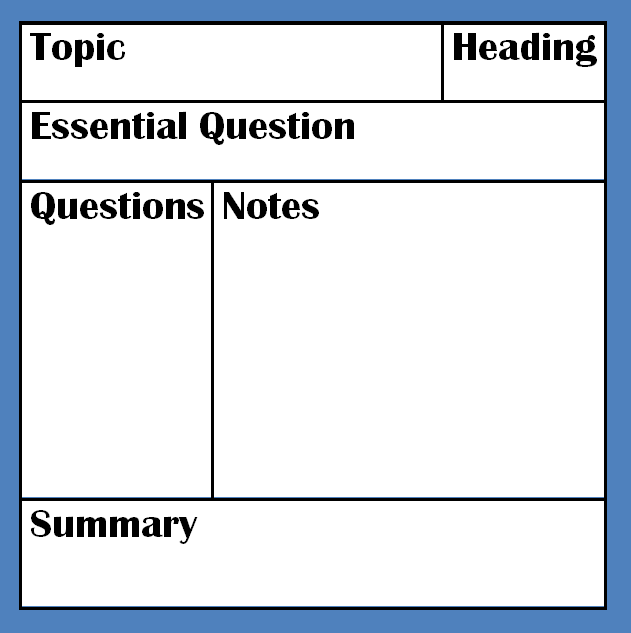
  

The steps listed are a part of effective studying regardless of the type of notes a student takes. Because of the way they are set up, Cornell Notes provide a ready-made template that facilitates this multi-stage approach to studying.

MisCornception #2: The best thing about Cornell Notes is that students can fold back the left column of the paper and use the sheet to study.  

The teacher who first introduced Cornell Notes to me was absolutely giddy at the idea that her students could fold back the left side of the page and--with the notes on one side of the paper and the questions on the other--quiz themselves about the content of the notes, flipping the page over to check for understanding as they studied. I remember thinking to myself, “If the students have Level 1 comprehension questions on the paper that are answerable in the notes themselves, wouldn’t it be more efficient and just as easy to make flashcards instead of Cornell Notes?”

What that teacher and I didn’t understand is the theory behind Cornell Notes. A German researcher named Hermann Ebbinghaus in 1885 found that our brain is highly adept at forgetting information. He developed a theory known as the Curve of Forgetting that showed that newly information disappears from our brains rapidly unless we do something to stop that from happening. The two main ways to thwart forgetting are to do something meaningful with the information and to revisit the information repeatedly. That’s what Cornell Notes are designed to do; they encourage students to create memorable, thoughtful notes of their own and then to interact with them multiple times as they revise, chunk, create questions, and summarize. The fold-the-flap Cornell Notes study method does address the repetition feature necessary for long-term remembering of information, but it ignores the rest of the procedure.    

MisCornception #3: Note-takers complete the question column and the notes section at the same time.

In order for the process above to work, students complete the notes on the right side, revise those notes, and THEN write questions. If these things happen simultaneously, there’s no chance for students to experience the repetition and variety of thinking processes necessary to make Cornell Notes work as a study tool.

MisCornception #4: The teacher needs to provide guiding questions for the left column.

If you do this, you are depriving your students of the chance to interact meaningfully with the content on their own. I’ve seen teachers who ignore the question part of the notes completely, and instead tell their students the topic heading to write in that space in the left column. The result is a nicely organized page of notes that does not prompt students to do any further thinking. This keeps the learning firmly grounded in the lower levels of Costa’s or Bloom’s. A better approach is to include these subject headings within the notes themselves on the right side of the page. Or, if you love the idea of headings floating out to the side, add an additional column for the headings, and make your Cornell Notes three-column notes that still allow students to follow up the note-taking with questioning.   

MisCornception #5: The answers to the questions on the left side of the page should be answered in the notes on the right side.

The goal of the questions is to push students to think at higher levels about the content: to compare and contrast, to make inferences, to evaluate, to predict, to draw conclusions. If the questions are answered in the notes themselves, the learning is Costa’s Level 1. While this may be desirable for emerging learners struggling to grasp onto the concepts, it’s not ideal for most kids. Higher-level questions lead to higher-level thinking, higher-level engagement, and higher-level understanding.

MisCornception #6:  Cornell Notes restrict my students to one style of note-taking.

Not at all! There’s no one correct way or preferred method to take the notes on the right side of the page. Some students like formal outlines while others prefer bullet points or even mind maps with drawings. Hand-drawn or pasted-in diagrams and figures can appear in the notes, too. Some pre-printed versions of Cornell Notes have lines to write on in the note-taking area; others are unlined for students whose notes are less linear. The type of notes is not what’s important in Cornell Notes; what you do with the notes is what matters.

MisCornception #7:  Cornell Notes are the panacea for all my students’ study issues.

Simply using the format of Cornell Notes is not going to turn your students into scholars overnight. Teaching and modeling how to take notes effectively, how to revise the notes with meaning in mind, how to write worthwhile questions, how to compose a clear and precise summary, and how to use the notes as a study tool will nudge your students in the right direction. As they continue to practice and refine the process, you and your students will see results.  

MisCornception #8: The important things about the notes are their appearance and how many pages of notes the students take.

Pretty notes are useless notes. And more is not always better. To engage in the Focused Note-taking Process, students are going to mess up their notes by crossing out, circling, underlining, adding new ideas, and inserting sketches and symbols. The result may look a little sloppy. Not every student will take the same number of notes, either. Some students will need to be continually prompted and encouraged to write more, yet others will succumb to the perfectionist method of writing everything down and leaving nothing out. If you must take a grade on the notes, grade the evidence of learning rather than the number of notes or pages.


If I’ve done my job here, I’ve convinced at least a few of you haters that Cornell Notes deserve a second chance. They’re not just some cultish AVID thing; they’re a format to help your students develop research-tested habits for effective learning and studying. They’re versatile, interactive, brain-based, and less painful than you initially imagined.

Thursday, March 24, 2016

That's the Ticket

Tickets come in many types. There are the ones you don’t want to get from a police officer, the ones you hope you can score for the sold-out concert, the ones you have to sell an organ to afford so you can see Hamilton on Broadway, and the ones you hope will be picked out of the bucket so you can win a nifty raffle prize.  The type of ticket that is perhaps most useful in your life as a teacher, however, is an exit ticket.    

Exit tickets are a great way to formatively assess your students. They’re also easy to use. All you have to do is provide a quick assignment or question for students to complete during the final minutes of class. Their responses are their tickets to leave the room when the bell rings, and you can stand at the door and collect them as students depart. Flipping through the exit tickets helps you know how your class and individual students are doing.

Here are a few examples of the types of things you might ask your students to do on an exit ticket:  

Explain a key concept from the lesson.
List the three branches of the US government, and write one sentence explaining the function of each.

Explain in at least three sentences the effects of alcohol and tobacco use by a mother on the development of a fetus.   

Define a term or concept.
            Define “manifest destiny” in your own words.

Write a one-sentence definition for each of these terms: round character, flat character, static character, dynamic character.

Provide examples to show understanding.
Give an example of when you might need to be able to calculate the area of a quadrilateral in your life outside the classroom.

Thinking about the types of measurement we discussed today, provide an example of something that is best measured in each of these:  millimeters, centimeters, meters, kilometers.       

Give an opinion.
How are you liking the book you are reading? What are you enjoying most and least about it?

Which is more useful: fractions or percentages?  Why?

Make a comparison or contrast.
List ways that plant and animal cells are similar and different. Provide at least three similarities and three differences.  

Which character in the novel are you most like? Discuss at least three similarities.

Fill in a graphic organizer.
Create a Venn diagram to show similarities and differences between mitosis and meiosis.

Use a T-chart to list pros and cons for electing our President using the Electoral College.

Apply the learning.
Escribe dos oraciones en espaƱol sobre su familia.

Write three sentences using the same verb as a gerund, a participle, and an infinitive.

How might you use what you learned about primary and secondary colors to design a color scheme for a workplace? Explain your choices.

Solve a problem or work an example.
Copy a compound or complex sentence from the novel you are reading. Underline the nouns once, underline the verbs twice, and circle the adjectives.

Solve this equation on your exit ticket:
2x + ½(x +10) = 15

Evaluate their work.
Look back at your notes on the essay you revised today. How useful were your partner’s suggestions during your writing conference? What changes will you make on the next draft based on what you discussed? What could make your next writing conference more effective?

What did you do to prepare for your test? How, specifically, did you study? After going over your test results, what changes will you make next time to help you be more successful?

Reflect on today’s Socratic Seminar. What did the class do well? What did you do well? What should change next time to make the seminar better for you and for the class?

On a scale from 1-10, how would you rate your success in this class? Why did you give yourself that rating?

Pick out a main idea.
What was the most important thing you learned today?

Sum up the main ideas of today’s lesson in 20 words or fewer.

Draw a picture.  
Sketch a diagram of a plant cell and label as many parts as you can.

Draw a picture that summarizes the chapter you read today in the book. You may label your picture to clarify if your drawing skills are lacking.

Summarize the lesson or the content.
Write a 25-word gist statement about the TED Talk we watched today.

Write three sentences to explain what you learned today to someone who was absent for today’s class.

Choose a word.
Select one word that best describes the Cold War, and explain why you selected that word.

Choose two adjectives that describe the character of Lord Capulet, and use evidence from the play to support each choice.

Write a question. (These are great to incorporate into a follow-up activity later.)
What is one question you have after today’s lesson? If you have no questions, come up with a higher-level question to stimulate further discussion about the topic.  

            Write two questions about this topic that you’d like to discuss in class tomorrow.

Write one question at each of Costa’s Levels of Thinking about today’s lesson.

Ask for a response. (Teacher responds to these and hands them back the next day.)
What is going well for you in this class? What’s not?

What help do you need from me to complete your understanding of this subject?

Set a goal.
What grade do you hope to receive next grading period? What do you need to do to reach that goal?

After reviewing the peer and teacher feedback on your essay/project, what is the most important thing you’d like to focus on for the next one? Why?

Give the teacher feedback.
Write at least three sentences to me about what I can do to make this class a better experience for you.

Glows and Grows:  What is one thing I’m doing well as your teacher and one thing I can improve on?

If you could change one thing about this class, what would it be, and why?

Exit tickets can provide all sorts of useful information for us as teachers to clue us in to what our students know, what they need, and how we can help them. Whether you use old-fashioned pen-and-paper exit tickets or newfangled technology to get your feedback, exit tickets keep students engaged during the final minutes of class and provide meaningful closure to your lesson.


Tuesday, March 15, 2016

Today's Question

How do I create a daily guiding question for my students, and why should I consider doing it?

One of the things we know we are “supposed” to do as teachers is to post our learning objectives on the board. Maybe we are doing it because our principal told us to. Perhaps we are hoping our students will read them and have a more secure grasp on what they are supposed to get from the day’s lesson. Or it’s just something we do without thinking; at the beginning of the unit we create a poster or reserve a spot on the board where we dutifully copy a bunch of educational jargon so that it’ll be there if anyone chooses to look at it.

The problem with learning objectives is that they’re often written for teachers, not for students.

How can I expect students to use a statement like this (one of many I could have pulled from the English I TEKS) to guide their learning when I don’t even want to read it myself?

“Students understand, make inferences and draw conclusions about the structure and elements of fiction and provide evidence from text to support their understanding. Students are expected to analyze how authors develop complex yet believable characters in works of fiction through a range of literary devices, including character foils.”

Not only is it so wordy that I’d get a hand cramp writing that on the board with dry-erase markers, but it also makes it sound as if the student is about to have to sit through the most tedious lesson imaginable, right?

Sometimes we take a giant Essential Question for an entire unit (like this) and post it on the board:  

“What deliberate decisions do authors make as they write to influence their readers?”

Sure, this is the big idea we want our students to ponder throughout the unit, but it’s unlikely they’ll be exploring that in depth every day while they should be having learning experiences that lead them to the eventual answer to that question. I think it’s a great idea to have the Essential Questions posted somewhere in the room so you can refer to them and the students can continue to ponder them, but I think they’re not the best way to help students focus on what they’re supposed to be taking away from any particular class period.

What I always found to be most helpful for me and my students was to compose a separate question for each day’s lesson. Sometimes, I’d create my question first to help focus my planning and preparation. Other times, when I already had an idea of what I was intending to do that day, I’d write the question at the end of planning in an effort to tie everything together and make sure my lesson made cohesive sense.

My guiding goal for making the question was to make sure the question was in student-friendly language and was something the students should be able to answer at the end of the class period:

What is a dramatic foil, and why does Shakespeare create them?

That’s the question I’d create for that unwieldy learning objective I shared with you earlier. Here are some other samples so you can get the gist:

What are the characteristics that reappear in Romantic art?

What were the main causes that led up to World War I?

How do I use percentages to determine what I will pay for an item on sale?

How is meiosis similar to and different from mitosis?

How can using poetic devices spice up my writing?

Once you get a little practice, you’ll find that writing these questions is easy and fairly painless. Once you start using them on a daily basis, you’ll see their benefits:

  1. You’ll have a better idea of what your goal is during the lesson. Consequently, your lessons will be more focused and will have renewed purpose and direction.
  2. Your students will know what they’re supposed to learn during your class. It’s important, of course, that you pause at the beginning of class to alert your students to the question and to let them know that they should be able to answer that question at the end of the period. If you’re feeling really crazy, you can have your students write down the question at the top of their notes or in a notebook. Then, when it comes time to study for the test, they’ll have a clear reminder of what they were supposed to have learned during the unit.
  3. You can use the question at the end of the class to check for understanding. Try using the question as the prompt for an exit card. You can collect them at the door as students leave and, after flipping through them, you will have a clear picture of how well the class as a whole and particular students mastered the day’s objective. Then you’ll know what kind of reteaching, if any, is necessary.
  4. Your students can use the question as a self-test to measure their own understanding of the lesson. This will give them a better idea of where and when they need to seek further help.

Your daily guiding question was the first sentence of this article. Look back at it and see if you can answer it now. If not, let me know, and I’ll be happy to help.

Monday, December 7, 2015

Can Costa's Levels of Thinking Make Me a Better Teacher?


For years I've used Costa’s Levels of Thinking in my AVID, English, and Humanities classrooms to help my students push themselves to higher levels of cognition and to assist them in analyzing their own thinking on assignments and assessments. When going over the results a test, I've asked students to identify the levels of thinking required by the questions that have posed a challenge for them. Knowing what kind of thinking is tripping them up has allowed them to refine their study skills for continued growth. We've written questions together and dissected the questions of others. Costa’s Levels of Thinking have made a world of difference in the way my students learn.  

Recently, I had an epiphany. Not only can Costa’s increase student success, but improvement-minded teachers can use Costa’s to shape and guide their own instructional efforts.  


Costa’s Level 1 refers to the information-gathering stage of thinking. This is the realm of right and wrong answers. Level 1 thinkers simply need to know facts and ideas that others thought of first. Level 1 knowledge is essential for every teacher. Not only must teachers know the nuts and bolts of their subject matter, but they also must understand the state’s essential elements or standards, the district’s curriculum (if such a thing exists), and the rules and policies of the school. Spending time studying lessons on the curriculum database, reading instructional materials, boning up on content, discussing curriculum maps, familiarizing yourself with the textbook, and perusing the TEKS involves necessary Level 1 thinking. Teachers should also be aware of student data: What are the specific strengths and weaknesses of my students, as a class and as individuals?

Effective teachers can’t stop with Level 1 knowledge, though. Level 2 thinking--the kind where you do something with the Level 1 knowledge by applying and analyzing what you know--must take place so teachers can bring instruction to life.

Level 2 thinking for teachers involves customizing the curriculum and standards for their individual campus situations. Teachers consider the needs of their students to determine what instruction needs to look like. Classrooms with multiple ability levels or multiple levels of understanding suggest opportunities for differentiation. In other words, the Level 2 thinking forces teachers to consider how to most effectively implement instruction. It also requires teachers to connect the dots between the elements so that instruction is seamless and has a recognizable direction. Level 2 is the problem-solving stage. It’s all about putting what you know into action.  

More importantly, Level 2 thinking also requires teachers to ask themselves, “Why?” Why am I teaching this content? Why is this skill necessary for my students to learn? Why is the curriculum written the way it is?  What is the thinking behind this curriculum document? When a teacher can articulate the “why” behind the subject matter and curriculum, students will understand the “so what” for the things they’re asked to do.    

Level 3 thinking occurs during and after the lessons are taught. Teachers view their instruction through an evaluative lens. What went well? What didn’t? Why? What do I need to do differently next time? Did my students perform to expectation? If not, how will I need to adjust to remediate or reteach?  Often, I find that as teachers we rush from one activity or assessment to the next and don’t allow ample time for reflection and growth. Level 3 of Costa’s reminds us of the importance of evaluation; it’s how we get better at what we do. The best teachers--like great athletes--are always self-assessing and making microadjustments as they teach, sometimes even in the middle of lessons.

Sometimes, teaching also provides the satisfying Level 3 task of creating. Teachers--individually or on campus or district curriculum teams--take everything they know about learning, content, standards, and students and synthesize all that knowledge to produce thoughtful curriculum units and lessons to engage students and meet their needs. It’s a monumental task that requires the teacher to be simultaneously detailed and visionary.  

I encourage my teacher friends to join me in some metacognition about Costa’s and their own journeys in education. Take stock of the thinking you’re doing and consider what you can do to strengthen any areas of weakness. Let Costa’s Levels of Thinking guide you toward continual improvement. It’s what we’d expect from our students, so I think it’s worth expecting of ourselves.


Tuesday, October 13, 2015

The WICOR of Reading: Reading and Inquiry

Peanut butter and jelly. John and Yoko. Hayrides and Claritin. Reading and inquiry. Some things just go together well.

Effective readers practice inquiry all the time, perhaps not even aware they're doing so. We make predictions. We pose questions in our heads. We challenge an author's basic assumptions. We examine the validity of claims. We judge based on self-created standards of good and bad or effective and ineffective. We connect our reading to our own lives, to the world around us, and to other things we have read.

Students who struggle with reading often accept what they read at face value and don't dare to engage with the text at a higher level. It's our job as teachers to hold their hands as they wade into the waters of inquiry so they can eventually swim on their own.

Inquiry connects to the act of reading before, during, and after the reading itself occurs.

Before reading, teachers can pose an open-ended question or scenario for students to discuss to make their minds and/or hearts receptive to what they're about to read:

What would happen if you had to leave your family and survive on your own?
Which is better: a life without stress or a life with some stress? Why?
What makes a good scary story?
What are all the things in your possession that are made from plants?
How important are material possessions in achieving popularity?

Questions like these get students thinking about a topic and prepare them for some reading that connects in some way to the subject.

During the reading itself, students can be encouraged to interact with the text by writing their own questions in the margins or on sticky notes. Or ask them to keep track of the thinking they're doing as they read and share that with the class afterwards. Your students may also benefit from hearing you do a Read-Aloud/Think-Aloud in which you read the text to them and comment aloud about the things you're thinking and questioning as you read. Letting them witness a model of what's going on in an effective reader's head helps your students fill their toolboxes with strategies they can use as they read independently.

After reading, your options for inquiry are plentiful. I'm always a champion for using Costa's Levels of Thinking to compose questions for further discussion. Your students will quickly find that Level One questions (the ones with right answers) don't generate much discussion, but they may be essential questions to ask to check for literal understanding. Also, I like to remind students that if a discussion is boring after they wrote the questions, that's their fault. Next time, they should work to come up with some questions worth discussing. For optimal pairing with the reading, remind students to write questions that require revisiting the text to support an answer.

I have had good luck asking students to write questions they'd like to ask the author of the text. If the author is alive and reachable via social media or e-mail, you might have fun selecting the best questions from your class and asking the author directly. Getting a response from a living writer makes the learning come alive and prompts student interest in the text. To "tech up" your classroom, consider using a website like Tricider to allow students to comment or vote on one another's questions to select the best ones.

For general inquiry-based discussions after reading, try circling up the chairs for a Socratic Seminar over the text using student-generated questions. You can find scads of resources to help you conduct Socratic Seminars on the internet, the AVID website, and YouTube. Remember that the purpose of a Socratic Seminar is to foster genuine collaborative discussion to deepen the class's understanding of what they read. If the topic of the reading lends itself to a debate format, consider a Philosophical Chairs discussion instead. Whatever you do, make sure you leave time to debrief the process of the discussion itself at the end; that's the only way to improve the quality of future discussions.

One of the top skills employers seek in management-level employees is the ability to ask questions. By bringing inquiry to the forefront of your classroom, you're not only preparing your students for the rigors of the work world but you're also handing them the key to increased reading effectiveness and the ability to learn on their own. What could be more important than that?