In my younger days, I thought Brussels sprouts were icky, loved Big Macs, and believed that wearing a neon blue t-shirt with acid-washed jeans was a smart fashion choice. Now that I have discovered the virtues of roasting Brussels sprouts with olive oil and sea salt, have seen the nutritional info on McDonald's signature burger, and have reviewed photographs from my high school days, I have rethought my previous beliefs, and I feel pretty good about my current opinions.
Changing one’s mind gets a bad rap these days. In the world of politics, for instance, candidates are vilified for changing their stances. A politician who cast a vote in support of an issue decades ago and votes against it today receives a lambasting from the voting public and media for flip-floppery. Congresspeople on both sides of the aisle dig their heels in and refuse to cross party lines, even in the face of overwhelming evidence that might cause any reasonable person to revise his or her original opinion. We have become a nation of extremely opinionated individuals who intend to stick to their opinions and never budge.
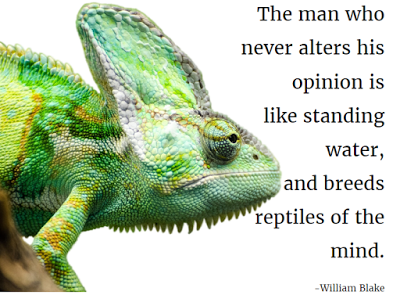
The 18th century British poet William Blake penned one of my favorite quotations: “The man who never alters his opinion is like standing water, and breeds reptiles of the mind.” In college when I first read Blake’s The Marriage of Heaven and Hell, I was drawn to this quotation partly because it contained a wildly descriptive simile but mostly because it embodied what I saw as a clarification of the point of education.
An educated person never stops growing. Constantly seeking new ideas and other perspectives, a learner continues to refine his or her views and ideas about the world. Each new viewpoint or piece of knowledge shapes the learner in some way. The learner considers the new input, measures it against his or her prior understanding, and decides how to integrate it into the whole--to reject it, to accept it, to alter his or her understanding. Sometimes, when presented with compelling new evidence, a learner even changes his or her opinion.
In contrast, the person who has stopped learning doesn’t consider other views or compelling evidence and thus remains fixed in thought, belief, and practice. That person, as Blake concluded, “is like standing water, and breeds reptiles of the mind.” That can’t be good, can it?
I think about how this factors into my own journey as an educator. Looking back at what I believed during my fledgling years, I’m glad to have had exposure to new research and theory that has helped shape my practice. Some of the elements I considered vital components of my English classroom back in the 90s--grammar worksheets, study packets, comprehension questions, teacher-provided vocabulary lists, multiple-choice tests to assess comprehension--would not be found there today. Each new piece of information I take in and every conversation with a fellow educator shapes my own philosophy of teaching.
To ward off reptiles of the mind in our students, teachers must reinforce the importance of learning as a growth experience. We must continually challenge them to question their own thinking. We must dare them to form opinions for themselves and not look to their peers for constant approval. We must encourage mental flexibility, not rigidity. We must help them learn to read and listen to understand and to write to be understood. We must model an openness to new ideas that don’t always echo our own. We must make it noble to admit, "I once held this opinion, but now that I've considered some new perspectives and data, I have changed my mind."
One of my favorite AVID strategies for encouraging this type of thinking is Philosophical Chairs. In a nutshell, Philosophical Chairs is a form of whole-class debate. Students read a text or pair of texts that provides information or ideas that could be used to support both sides of a controversial issue. Typically, students mark the text and then quick-write to clarify their opinions on the topic. Then, they move to chairs placed on either side of the room to indicate what position they plan to support in the debate. Sides alternate speaking, offering supports for their side (ideally, going back to the text) or responding to comments of their opponents. Here’s the kicker, though. If a student is swayed by the other side’s arguments, that student can relocate to the other side or to a non-debating neutral zone to physically indicate that his or her stance has changed. As students listen to one another and discuss, they deepen their own understandings of the issue, and, as ought to happen in an intellectual discussion, they sometimes change their ways of thinking.
Using strategies like Philosophical Chairs is an excellent way to model the kinds of behaviors appropriate for intellectual discourse and disagreement in an academic setting. Mudslinging, name calling, and personal attacks are forbidden. When cool heads and open minds prevail, people listen, learn, and grow.
Educators are tasked with one of the biggest and most important jobs in the world: creating a citizenry who will not only survive but will thrive in a rapidly changing world and will shape the future for the betterment of all. Reptiles of the mind have no place in an environment where such essential work is taking place. We must continue to think and grow so our students will do the same.
