MisCornceptions
What People Don’t Get About Cornell Notes
I have a confession to make. For the first few years after my school adopted AVID, I hated Cornell Notes. I just didn’t see the point of them. All this hoopla over a two-column sheet of paper seemed overdone and ridiculous. And stupid. That’s right. I thought Cornell Notes were stupid.
Since that time, however, I’ve grown in my knowledge and understanding of the AVID Focused Note-taking system and, now that I comprehend the “why” of Cornell Notes, I have become quite a fan.
Perhaps there are a few of you who are like I used to be--skeptical of the effectiveness of this note-taking style AVID has so enthusiastically championed. You’re the target audience for this week’s Wednesday WICOR. I hope to address some of the common misCornceptions about Cornell Notes and help you see how your students can benefit from using this brain-based system for studying and learning.
MisCornception #1: Cornell Notes are more about the format than about the thinking involved.
There’s nothing magical about the piece of paper a student uses to write Cornell Notes. In fact, a student could create similarly effective notes using a number of formats as long as the process used for note-taking remains intact. This process consists of several steps: 1. Setup: The student sets up the notes with a topic and an essential question (usually provided by the teacher). 2. Note-taking: The students takes notes over the reading, lecture, video, or other input in whatever style they prefer. 3. Revising: “To revise” literally means “to look again,” and this stage is when the student looks again at the notes with a critical eye to make better sense of them. The student returns to the notes to organize, to edit, to emphasize important ideas, to add missing information, to clarify, to delete extraneous information, and perhaps to color-code or highlight. During this stage, the student may revisit the notes multiple times for different purposes, and one of those visits may include “chunking” the notes, dividing them into logical segments or sections based on content and organization. 4. Questioning: Students create thoughtful questions about each chunk of their notes that require them to process information at a higher level. Depending on the student’s mastery of the topic, the questions may target points of confusion or gaps in understanding, or they may take the students into deeper levels of inquiry about the topic of the notes. AVID suggests using Costa’s Levels of Thinking to guide the creation of Level 2 and 3 questions for the notes. Students can spend time collaborating with classmates or study groups to explore the questions they pose. 5. Summarizing: The final stage asks students to create succinct summaries of the notes, which requires them to sift out the the most important information from the notes to arrive at an understanding of the big picture. Most of the time, the summary will answer the essential question they have written at the top of their notes and will include some information from each chunk of the notes.
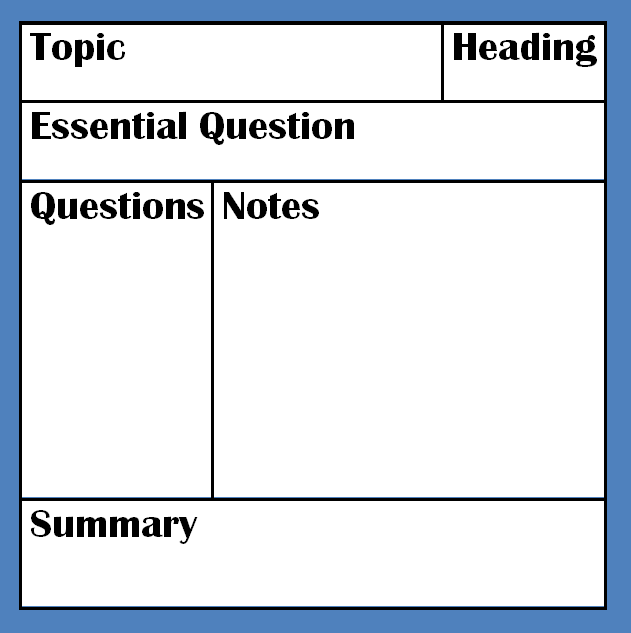
The steps listed are a part of effective studying regardless of the type of notes a student takes. Because of the way they are set up, Cornell Notes provide a ready-made template that facilitates this multi-stage approach to studying.
MisCornception #2: The best thing about Cornell Notes is that students can fold back the left column of the paper and use the sheet to study.
The teacher who first introduced Cornell Notes to me was absolutely giddy at the idea that her students could fold back the left side of the page and--with the notes on one side of the paper and the questions on the other--quiz themselves about the content of the notes, flipping the page over to check for understanding as they studied. I remember thinking to myself, “If the students have Level 1 comprehension questions on the paper that are answerable in the notes themselves, wouldn’t it be more efficient and just as easy to make flashcards instead of Cornell Notes?”
What that teacher and I didn’t understand is the theory behind Cornell Notes. A German researcher named Hermann Ebbinghaus in 1885 found that our brain is highly adept at forgetting information. He developed a theory known as the Curve of Forgetting that showed that newly information disappears from our brains rapidly unless we do something to stop that from happening. The two main ways to thwart forgetting are to do something meaningful with the information and to revisit the information repeatedly. That’s what Cornell Notes are designed to do; they encourage students to create memorable, thoughtful notes of their own and then to interact with them multiple times as they revise, chunk, create questions, and summarize. The fold-the-flap Cornell Notes study method does address the repetition feature necessary for long-term remembering of information, but it ignores the rest of the procedure.
MisCornception #3: Note-takers complete the question column and the notes section at the same time.
In order for the process above to work, students complete the notes on the right side, revise those notes, and THEN write questions. If these things happen simultaneously, there’s no chance for students to experience the repetition and variety of thinking processes necessary to make Cornell Notes work as a study tool.
MisCornception #4: The teacher needs to provide guiding questions for the left column.
If you do this, you are depriving your students of the chance to interact meaningfully with the content on their own. I’ve seen teachers who ignore the question part of the notes completely, and instead tell their students the topic heading to write in that space in the left column. The result is a nicely organized page of notes that does not prompt students to do any further thinking. This keeps the learning firmly grounded in the lower levels of Costa’s or Bloom’s. A better approach is to include these subject headings within the notes themselves on the right side of the page. Or, if you love the idea of headings floating out to the side, add an additional column for the headings, and make your Cornell Notes three-column notes that still allow students to follow up the note-taking with questioning.
MisCornception #5: The answers to the questions on the left side of the page should be answered in the notes on the right side.
The goal of the questions is to push students to think at higher levels about the content: to compare and contrast, to make inferences, to evaluate, to predict, to draw conclusions. If the questions are answered in the notes themselves, the learning is Costa’s Level 1. While this may be desirable for emerging learners struggling to grasp onto the concepts, it’s not ideal for most kids. Higher-level questions lead to higher-level thinking, higher-level engagement, and higher-level understanding.
MisCornception #6: Cornell Notes restrict my students to one style of note-taking.
Not at all! There’s no one correct way or preferred method to take the notes on the right side of the page. Some students like formal outlines while others prefer bullet points or even mind maps with drawings. Hand-drawn or pasted-in diagrams and figures can appear in the notes, too. Some pre-printed versions of Cornell Notes have lines to write on in the note-taking area; others are unlined for students whose notes are less linear. The type of notes is not what’s important in Cornell Notes; what you do with the notes is what matters.
MisCornception #7: Cornell Notes are the panacea for all my students’ study issues.
Simply using the format of Cornell Notes is not going to turn your students into scholars overnight. Teaching and modeling how to take notes effectively, how to revise the notes with meaning in mind, how to write worthwhile questions, how to compose a clear and precise summary, and how to use the notes as a study tool will nudge your students in the right direction. As they continue to practice and refine the process, you and your students will see results.
MisCornception #8: The important things about the notes are their appearance and how many pages of notes the students take.
Pretty notes are useless notes. And more is not always better. To engage in the Focused Note-taking Process, students are going to mess up their notes by crossing out, circling, underlining, adding new ideas, and inserting sketches and symbols. The result may look a little sloppy. Not every student will take the same number of notes, either. Some students will need to be continually prompted and encouraged to write more, yet others will succumb to the perfectionist method of writing everything down and leaving nothing out. If you must take a grade on the notes, grade the evidence of learning rather than the number of notes or pages.
If I’ve done my job here, I’ve convinced at least a few of you haters that Cornell Notes deserve a second chance. They’re not just some cultish AVID thing; they’re a format to help your students develop research-tested habits for effective learning and studying. They’re versatile, interactive, brain-based, and less painful than you initially imagined.
