Wednesday, June 1, 2016

Your Teacher WICOR Summer Homework

As school draws to a close, here are my suggestions (using AVID’s WICOR acronym) for some relaxing summer professional development for those times when you want to think a little about work but don’t want to hunker down in full-throttle school-preparatory efforts. 

Writing:  Keep a journal of your summer travels or recording your daily thoughts in your off time.  In addition to allegedly being therapeutic, journaling allows you to flex your writing muscles, something we ask our students to do but perhaps don’t practice often enough ourselves.  If you get stuck about what to write, push through your writer’s block and just write something.  Then you’ll have empathy for what many of your students experience.   

Inquiry:  Make a list of interesting get-to-know-you questions that go beyond the usual where-were-you-born/do-you-have-any-hobbies variety.  Use Costa’s levels of thinking to craft some intriguing higher-level questions.  Cut the questions up into slips or write them on cards and put them in a jar that students can draw from throughout the fall semester for ice-breaking impromptu speeches.  It’ll be a fun way to get to know your students when school starts back up. Test them out on your friends or family one afternoon while you’re lounging around the pool or take your questions with you on a road trip. 

Collaboration:  Find a professional community online of other teachers who teach the same subjects or have similar interests and concerns as you.  Join a Facebook group, follow some Twitter feeds, or read some blogs.  Having others with whom to share ideas, solve problems, or brainstorm will enhance your effectiveness as a teacher and may even help you through some rough spots.  

Organization:  Evaluate the efficiency and effectiveness of your classroom routines. How do you manage materials?  Collect assignments?  Deal with discipline, requests for restroom breaks, absences, make-ups, and late work?  Do you communicate with students and parents in effective ways?  Sometimes our best ideas come when we identify an area for improvement and then give ourselves time to ruminate on a solution.  Identifying the problem areas early in the summer and jotting them down somewhere will start your brain thinking about how you’ll do it better in the fall.   

Reading:  Take home one professional development book from school and actually read it.  And then read a bunch of stuff for fun.  Write down the names of things you enjoyed and share them with your students or colleagues next year.  I recommend When Kids Can’t Read by Kylene Beers; Classroom Instruction that Works by Marzano, Pickering, and Pollock; What Great Teachers Do Differently by Todd Whitaker; The Gift of Failure by Jessica Lahey; and Overcoming the Achievement Gap Trap by Anthony Muhammad. For non-professional reading, I suggest Everything I Never Told You by Celeste Ng, The Storied Life of A.J. Fickry by Gabrielle Zevin, The Woman in White by Wilkie Collins, Better Nate Than Ever byTim Federle, the I Hunt Killers series by Barry Lyga, Far Far Away by Tom McNeal, and We Are Called to Rise by Laura McBride .


Of course, this homework is completely optional and will not be graded in the fall.  It might, though, help you be more prepared for what you’ll be facing when you return to school in August. I hope you have a restful and relaxing summer and come back refreshed and ready for a great school year.  

Monday, May 23, 2016

If I Could Get a Do-Over

I have always been fairly inept at playground and backyard games. I was a better target than I was a hurler of dodgeballs. I was the weak link in the Red Rover chain. And I lacked the necessary coordination to be skilled at soccer and football.

My one-year-younger brother, Kevin, was a natural athlete. Sometimes, I’d wind up playing some sort of game--basketball, football, soccer--with him and other kids in the neighborhood. Kevin was a master of the mysterious-to-me concept of the “do-over.” He possessed the knowhow to stop the game after a terrible move (a missed shot, a poorly executed play, a flubbed field goal, or a similar embarrassment) and ask, “Can I get a do-over?” There was never any discussion. We just backed up the game and redid what had just occurred. It was the pick-up game equivalent of a Get Out of Jail Free card in Monopoly.

I’m not sure that I ever called for a “do-over,” probably because I wasn’t confident that my second attempt would improve on whatever I had done terribly. Or maybe I didn’t understand the “do-over” protocol in detail and was hesitant to try to redeem one.

If I had to call a “do-over” today, however, it wouldn’t be on the athletic field. Instead, I’ve been thinking a lot about what I’d do differently if I were to return to the classroom.

This year I’ve had the opportunity to visit hundreds of classrooms and to talk with outstanding teachers across the district. I’ve witnessed tiny and large-scale miracles, seen significant progress occur over time in particularly challenging classes of students, and had the time to engage in professional learning and reflection about curriculum and instruction.

Some of what has made me uncomfortable this year occurred when I noticed things that I routinely did in my classroom that I now recognize as practices that need revisiting. Knowing what I now know, if I could call a do-over for my 22 years in the classroom, here are six things I’d do differently:

  1. Change the way I provide feedback. As I look back on the thousands of words I have written and the millions of red marks I’ve made on my students’ papers over the years, I realize that often my purpose in writing those comments was to justify a grade. If I circle enough of your spelling and punctuation errors, that’ll prove that you deserve the C you’re receiving on this essay. What I should have been doing instead was conserving my energy for creating meaningful, actionable feedback for improvement. The purpose of feedback is to help students get better at what they’re doing. Feedback that is not heeded is a waste of time for the teacher and the student. Furthermore, destructive rather than constructive feedback doesn’t do much to motivate students: Even though I gave you an A, here’s all the stuff you did wrong.  If I had a do-over, I’d give my students concrete advice on how to improve and provide them with time and opportunities to apply that feedback to the same assignment or to another one with similar aims.  
  2. Rethink my reasons for giving assignments. I am guilty of giving assignments for dubious reasons: The kids need to be accountable for this. If I don’t take a grade on it, they won’t do it. My students need to learn responsibility and the value of hard work. Parents will want to see a certain number of grades in my gradebook at this point. The grading period is ending, and the kids need another major grade. If I don’t give them a picky quiz, how will I know they read? My students didn’t do so well showing mastery on the test, so they need a project to raise their grades. They ought to be doing some work for my class outside of class.  From what I’ve learned this year, I now believe that assignments should fulfill one of several purposes:  to allow students to acquire new information or content that they will do something else with in class, to practice new skills, and to demonstrate mastery. The grades students receive should communicate to the students and parents the student’s level of mastery of the course objectives. Every assignment should be relevant to the overall learning targets of the course. My do-over classroom would have fewer assignments, fewer grades, more opportunity to practice, and a gradebook that contains useful data for students and parents about progress and mastery.
  3. Facilitate structured student talk, not just student talk. I was not a teacher who was consistently guilty of doing all the talking. My students spent a great deal of time interacting with others and processing what they were learning. What I didn’t do, however, was put structures in place to make sure all students were contributing equally to the conversation. If I were to look back at a video of my classroom, I’d see the same eager students doing most of the talking in full-class conversations, and I’d watch many students sit by quietly as their peers did the talking and thinking for them. In my do-over, I’d set up more specific parameters for student talk--timed pair/shares, round-robin discussions, assigning A and B partners with different talk tasks--with accountability built in for each student to participate. By doing this, I’d keep the learning conversations flowing with participation by all.  
  4. Provide more formative feedback and less summative feedback. Why, oh why did I watch students work on projects and assignments and not give more helpful feedback along the way? More writing conferencing, more group huddles, and more check-ins along the way would be a routine part of my do-over classroom. I’d spend time commenting on earlier drafts before students turned them in for final grading so that my students could reap the benefits of putting that feedback into practice. I’d check in with groups working on presentations and projects and give them more guidance prior to their actual due date. Students should receive feedback when they can still do something about it; there’s no sense in expending effort telling students what they should have done at the end if they have no opportunity to learn from that.
  5. Be more flexible about grades. In the movie The Wizard of Oz, after the house squishes the Wicked Witch of the East, another witch shows up in all her greenish glory to claim her sister’s ruby slippers. Glinda, the smug witch of the North, points to the sparkly shoes on Dorothy’s feet and tells the witch, “It’s too late! There they are and there they’ll stay.” I fear that sometimes I might have been that smug teacher who, when students discovered a low grade in the gradebook, just looked at them with feigned regret and said, “It’s too late. There the grade is, and there it’ll stay.” It’s the teacher equivalent of “Too bad, so sad,” and it must be as frustrating to the students as Glinda’s proclamation was to her bright green nemesis. And, honestly, what’s the benefit of a low reading quiz grade to a student? Does it motivate her to go back and read the history chapter? Not if she can’t improve her grade by doing so. If I had to do it over again, I’d offer more opportunities for students to demonstrate mastery and raise those grades. My gradebook would be a fluid work in progress throughout the grading period. I know providing students with multiple attempts at mastery would be unwieldy at times and that there would have to be limits put in place for the sake of practicality, but students learn at different speeds and shouldn’t be penalized for taking a little longer if they are demonstrating legitimate effort along the way.
  6. Keep my big mouth shut. Here’s something I never felt bad about in my own class until I had the opportunity to watch teachers and students in other people’s classrooms. Students view the teacher as an expert. That’s not necessarily a bad thing since the teacher probably ought to know more than the students about the subject that’s being taught. The problem occurs when the teacher is trying to facilitate student discussion about, say, a work of literature or art. As soon as the teacher gives an opinion, students view that as the right answer or correct interpretation, and they consider their own points to be less valid. In the classroom, I often concluded student discussions with a final summation containing my own opinion. In my do-over fantasy, I’d learn to keep my big mouth shut sometimes and let the student discussion suffice. Sure, there would be times when I needed to ask a few artful questions to lead them closer to my way of thinking or help them notice an important point they missed, but I’d do my best to guide my students to arrive at the better response rather than waiting for me to make a proclamation of the Truth According to McKinney.
Teaching is part science and part art. Great teachers continually refine their craft. One of the best things about teaching is that, for most of us, we get a “do-over” every year with a brand new set of kids. You’ve seen my Top Six List of changes I’d make. What’s on your list?


Thursday, May 19, 2016

Lasting Impressions


“Don’t forget to stop and smell the roses.” My sixth grade math teacher, Mr. Roberts, wrote that in my Jackson Elementary yearbook. I had no idea what it meant at the time, and I had to ask my parents to interpret. They tried to explain, but I was probably too occupied with studying for the upcoming spelling test, reading enough books to qualify for the blue-ribbon certificate from the library, and going to my All-City Choir rehearsal to consider what Mr. Roberts was trying to say to me.   

In retrospect, Mr. Roberts was right. I’m hardwired for staying busy. I’ve spent a lifetime overscheduling my calendar and adding items to an unending to-do list.  I generally feel a bit guilty when I have downtime; I’m like a fast-food employee with a manager who barks, “If you’ve got time for leanin’, you’ve got time for cleanin’.” I’m a reluctant rose-sniffer.

From time to time, I’ll harken back to the words of Mr. Roberts and think about his wisdom. He could see in 12-year-old Craig a trait that would haunt me all my life, and his brief comment in my yearbook is among the most profoundly relevant things anyone has written to me.  Consequently, I make conscious efforts to slow down and enjoy things in the midst of my busyness. I pause to savor a great meal or watch a beautiful sunset. I carve out time to spend with the people I love. I grant myself permission to do nothing for a day, and I do my best to live that day guilt-free.

I’m not sure Mr. Roberts knew when he was signing my paperback yearbook that he was going to be someone I would still think about 35 years later. I don’t remember his being my favorite teacher or even one that I recall feeling a connection with in the classroom. But he is the only teacher whose advice I can quote to you today.

As adults who work with kids, we never know the impact we have on the students we teach. Just yesterday, I visited with a student I taught last year who told me how much he treasured a piece of advice I’d given him when he was a freshman. I had forgotten the conversation nearly completely until he reminded me. As a result of what we talked about, he's made some adjustments in the way he approaches school and prioritizes his time and activities. He seemed like a much happier and more balanced version of his earlier self.

In these final days of school, remember that you leave with your students more than just knowledge of a subject. What you have to share with them is more than content. You have the opportunity to change their hearts, to plant the seeds that will grow into something profound and life-altering in years to come.

The end of the school year is a pivotal time. As much as students are excited to be finished and move on, they are equally apprehensive about what lies ahead. You represent stability. You have seen them grow for a year or more. You might be someone they admire and see as a source of wisdom. You’ve got some credibility.

Be intentional about leaving your students with some wisdom that will guide them on their future journeys. Some of it will get tossed out the window on the road of life to litter the highway, but some of it will become a part of the map that guides that young person into a better future.


Wednesday, May 11, 2016

MisCornceptions

MisCornceptions
What People Don’t Get About Cornell Notes

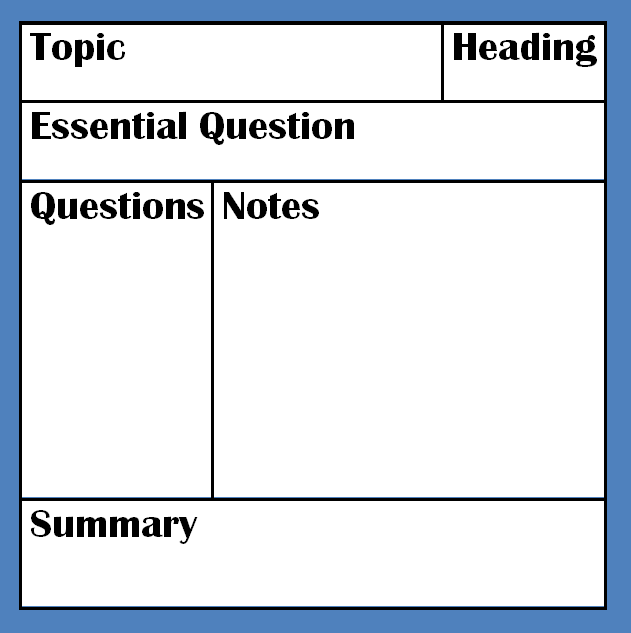
I have a confession to make. For the first few years after my school adopted AVID, I hated Cornell Notes. I just didn’t see the point of them. All this hoopla over a two-column sheet of paper seemed overdone and ridiculous. And stupid. That’s right. I thought Cornell Notes were stupid.  

Since that time, however, I’ve grown in my knowledge and understanding of the AVID Focused Note-taking system and, now that I comprehend the “why” of Cornell Notes, I have become quite a fan.

Perhaps there are a few of you who are like I used to be--skeptical of the effectiveness of this note-taking style AVID has so enthusiastically championed. You’re the target audience for this week’s Wednesday WICOR. I hope to address some of the common misCornceptions about Cornell Notes and help you see how your students can benefit from using this brain-based system for studying and learning.

MisCornception #1: Cornell Notes are more about the format than about the thinking involved.    

There’s nothing magical about the piece of paper a student uses to write Cornell Notes. In fact, a student could create similarly effective notes using a number of formats as long as the process used for note-taking remains intact. This process consists of several steps: 1. Setup: The student sets up the notes with a topic and an essential question (usually provided by the teacher). 2. Note-taking: The students takes notes over the reading, lecture, video, or other input in whatever style they prefer. 3. Revising: “To revise” literally means “to look again,” and this stage is when the student looks again at the notes with a critical eye to make better sense of them. The student returns to the notes to organize, to edit, to emphasize important ideas, to add missing information, to clarify, to delete extraneous information, and perhaps to color-code or highlight. During this stage, the student may revisit the notes multiple times for different purposes, and one of those visits may include “chunking” the notes, dividing them into logical segments or sections based on content and organization. 4. Questioning: Students create thoughtful questions about each chunk of their notes that require them to process information at a higher level. Depending on the student’s mastery of the topic, the questions may target points of confusion or gaps in understanding, or they may take the students into deeper levels of inquiry about the topic of the notes. AVID suggests using Costa’s Levels of Thinking to guide the creation of Level 2 and 3 questions for the notes. Students can spend time collaborating with classmates or study groups to explore the questions they pose.  5. Summarizing:  The final stage asks students to create succinct summaries of the notes, which requires them to sift out the the most important information from the notes to arrive at an understanding of the big picture. Most of the time, the summary will answer the essential question they have written at the top of their notes and will include some information from each chunk of the notes.   
  

The steps listed are a part of effective studying regardless of the type of notes a student takes. Because of the way they are set up, Cornell Notes provide a ready-made template that facilitates this multi-stage approach to studying.

MisCornception #2: The best thing about Cornell Notes is that students can fold back the left column of the paper and use the sheet to study.  

The teacher who first introduced Cornell Notes to me was absolutely giddy at the idea that her students could fold back the left side of the page and--with the notes on one side of the paper and the questions on the other--quiz themselves about the content of the notes, flipping the page over to check for understanding as they studied. I remember thinking to myself, “If the students have Level 1 comprehension questions on the paper that are answerable in the notes themselves, wouldn’t it be more efficient and just as easy to make flashcards instead of Cornell Notes?”

What that teacher and I didn’t understand is the theory behind Cornell Notes. A German researcher named Hermann Ebbinghaus in 1885 found that our brain is highly adept at forgetting information. He developed a theory known as the Curve of Forgetting that showed that newly information disappears from our brains rapidly unless we do something to stop that from happening. The two main ways to thwart forgetting are to do something meaningful with the information and to revisit the information repeatedly. That’s what Cornell Notes are designed to do; they encourage students to create memorable, thoughtful notes of their own and then to interact with them multiple times as they revise, chunk, create questions, and summarize. The fold-the-flap Cornell Notes study method does address the repetition feature necessary for long-term remembering of information, but it ignores the rest of the procedure.    

MisCornception #3: Note-takers complete the question column and the notes section at the same time.

In order for the process above to work, students complete the notes on the right side, revise those notes, and THEN write questions. If these things happen simultaneously, there’s no chance for students to experience the repetition and variety of thinking processes necessary to make Cornell Notes work as a study tool.

MisCornception #4: The teacher needs to provide guiding questions for the left column.

If you do this, you are depriving your students of the chance to interact meaningfully with the content on their own. I’ve seen teachers who ignore the question part of the notes completely, and instead tell their students the topic heading to write in that space in the left column. The result is a nicely organized page of notes that does not prompt students to do any further thinking. This keeps the learning firmly grounded in the lower levels of Costa’s or Bloom’s. A better approach is to include these subject headings within the notes themselves on the right side of the page. Or, if you love the idea of headings floating out to the side, add an additional column for the headings, and make your Cornell Notes three-column notes that still allow students to follow up the note-taking with questioning.   

MisCornception #5: The answers to the questions on the left side of the page should be answered in the notes on the right side.

The goal of the questions is to push students to think at higher levels about the content: to compare and contrast, to make inferences, to evaluate, to predict, to draw conclusions. If the questions are answered in the notes themselves, the learning is Costa’s Level 1. While this may be desirable for emerging learners struggling to grasp onto the concepts, it’s not ideal for most kids. Higher-level questions lead to higher-level thinking, higher-level engagement, and higher-level understanding.

MisCornception #6:  Cornell Notes restrict my students to one style of note-taking.

Not at all! There’s no one correct way or preferred method to take the notes on the right side of the page. Some students like formal outlines while others prefer bullet points or even mind maps with drawings. Hand-drawn or pasted-in diagrams and figures can appear in the notes, too. Some pre-printed versions of Cornell Notes have lines to write on in the note-taking area; others are unlined for students whose notes are less linear. The type of notes is not what’s important in Cornell Notes; what you do with the notes is what matters.

MisCornception #7:  Cornell Notes are the panacea for all my students’ study issues.

Simply using the format of Cornell Notes is not going to turn your students into scholars overnight. Teaching and modeling how to take notes effectively, how to revise the notes with meaning in mind, how to write worthwhile questions, how to compose a clear and precise summary, and how to use the notes as a study tool will nudge your students in the right direction. As they continue to practice and refine the process, you and your students will see results.  

MisCornception #8: The important things about the notes are their appearance and how many pages of notes the students take.

Pretty notes are useless notes. And more is not always better. To engage in the Focused Note-taking Process, students are going to mess up their notes by crossing out, circling, underlining, adding new ideas, and inserting sketches and symbols. The result may look a little sloppy. Not every student will take the same number of notes, either. Some students will need to be continually prompted and encouraged to write more, yet others will succumb to the perfectionist method of writing everything down and leaving nothing out. If you must take a grade on the notes, grade the evidence of learning rather than the number of notes or pages.


If I’ve done my job here, I’ve convinced at least a few of you haters that Cornell Notes deserve a second chance. They’re not just some cultish AVID thing; they’re a format to help your students develop research-tested habits for effective learning and studying. They’re versatile, interactive, brain-based, and less painful than you initially imagined.

Monday, May 2, 2016

It's Never Too Early

It’s Never Too Early
or
What to Think About While You Are Actively Monitoring

It’s likely that at some point in the next few days or weeks you will have several hours during which you are contractually obligated to monitor students while they are undergoing their state-mandated testing. You’re not permitted to be on the computer or your phone; to read; to grade papers; to look at the students’ tests; to write anything; to talk; to listen to music on your headphones; to eat a noisy, stinky, or nut-laden snack; to stand still; to sit for long periods of time; to sneeze; to sigh audibly; to laugh (maniacally or otherwise); to hover over a student long enough to make him or her nervous, to sing; to hum; to line dance; to juggle; to yodel; to take the test yourself; to snap photos; to work a jigsaw puzzle; or to arrange flowers. You get to walk around and think silently and unobtrusively for four or more hours.

What will fill your thoughts during this time? Some of my friends like to complete math problems in their heads. A few compile statistics about their test takers, mentally calculating the percentages by gender, hair style, clothing choice, handedness, etc. Others spend time memorizing the names and ID numbers of the students testing in their rooms. Still others fantasize about what they’d do if they had to opportunity to meet the person who created this standardized test or the legislator who mandated that it be taken.

I have another suggestion.

It’s never too early to start thinking about beginning the next school year. In fact, right now--during this second horrible round of standardized testing--is the perfect time to fill your idle mind with visionary thoughts about what next August can look like.

As you are actively monitoring, think about how you feel about the year-in-progress. What has gone well? What could improve? What is driving you crazy?

Perhaps there’s a new initiative you’d like to try out and have been waiting for the perfect time to do so. Want to redo the way you’ve been starting or ending class? Have you recently become intrigued by the concept of Interactive Notebooks? Maybe you’re an English teacher who wants to launch a full-scale Reader’s or Writer’s Workshop. Or you’ve wanted to be more intentional about incorporating AVID WICOR strategies to engage your students.

By this time in the year, you can clearly see what your beginning-of-school preparations have spawned. Ideally, your students are still enthusiastic, engaged, on-task, risk-taking, controllable, and eager to learn (with just a touch of unavoidable “summeritis”). You might, unfortunately, struggle daily with students who are cantankerous, unruly, discouraged, distracted, and disengaged.       

One of the great things about teaching is that most teachers get a “do over” each year. You greet a new set of students who enter your classroom (and maybe your school) for the first time. The students are full of excitement and apprehension, and you have the opportunity to set precedents, to let them know how things run in your classroom, and to clarify your expectations. Students are malleable and trainable at the beginning of the year. Effective training, like most complex tasks, requires careful prior planning. That’s why it’s never too early to get started.  

Don’t wait until the last days before school starts to try to remember what you wanted to do differently this time around. Spend some time now making your to-do list for beginning next year. Please don’t spend your entire summer vacation planning and plotting for next year; you need and deserve plenty of downtime. But having the pre-made list at the ready will allow your mind to focus quickly on the ideas when August hits and it’s time to ramp up for another school year.

Right now, when you’ve got nothing to do but monitor your students, is the best time I can think of to start composing your mental list. You may even have the time to troubleshoot a few of the problems and work out the kinks in advance.

If you don’t want to think about next year, you can always start thinking about what to buy me for my birthday. It’s only 140 days away, and I’m allegedly difficult to shop for. It’s never too early to start planning.

Friday, April 29, 2016

RAMPing Up the Rigor

Kids need to write, right?

They’re not going to get better at it if they don’t do it. Frequently. In every class.

You may be thinking to yourself, “But I’m not a writing teacher. I wasn’t taught how to teach writing. I’m not a confident writer myself. How can I possibly teach my students how to write?”

Relax a moment. I know that if you’ve read this far, you know how to read. You probably have even identified that I used a few sentence fragments in the preceding paragraphs, and you may or may not have been comfortable with my decision to do so. But since I know you know how to read, I also know that you can read a student’s writing and tell whether it makes sense and whether it says something. That’s the first step--and the most important one--to becoming a teacher whose students write.

I’m not asking you to become a writing teacher if you’re not one already and if the class you teach doesn’t require it. What I am asking is that, no matter what you teach, you ask your students to write.   

To help you make this happen, I’m going to clue you in on a little tip, an acronym many English teachers use that will jumpstart your ability to design interesting and rigorous writing: RAMP.  

RAMP stands for Role, Audience, Mode, and Purpose. These are four elements students can identify for themselves when they are dissecting a writing prompt:

Role: What persona or perspective am I adopting as a writer?  
Audience:  To whom or for whom am I writing?
Mode: What type of writing am I being asked to do (category and genre/format)? Probable types include narrative, expository, and persuasive.
Purpose:  Why am I writing this?

As I mentioned above, many teachers use this to help students determine what they’re supposed to do in response to a writing prompt. Decisions regarding word choice, degree of formality, organization, and content relate directly to the four elements of RAMP. I’m going to write in a different style if I’m writing a formal lab report for publication in a chemistry journal than I am if I compose a text message to a friend to find out about his date last Saturday.

Not only can RAMP be useful to students, but RAMP can come in handy for teachers who are trying to create more interesting real-world writing assignments for their students. Asking students to adopt different roles and to write for varied purposes not only can make writing more fun but also “ramp up” the rigor in writing assignments.

Here are some deconstructed writing prompt samples to help you see how easy (and perhaps even fun) creating writing activities using RAMP can be.

An old-school, boring essay topic:
Write an essay about the themes in Moby Dick. Select three themes, and support each with evidence from the novel.
            ROLE:  A student
            AUDIENCE: The bored English teacher
            MODE:  Expository/literary analysis
            PURPOSE: To inform and explain

A more exciting Moby Dick essay (spoiler alert):
You are the psychiatrist treating Ishmael as the lone survivor of the Pequod's sinking. Since the patient refuses to speak, you have only his manuscript (the novel Moby Dick) to use to diagnose him and recommend a treatment. Using the evidence, write a report to the hospital’s Board of Governors about your patient detailing the nature of the trauma, the effect on Ishmael, and your plan for treatment.
            ROLE: Hospital psychiatrist
            AUDIENCE: The hospital’s Board of Directors
            MODE: Expository/analytical
   PURPOSE: To analyze Ishmael’s character and what mental or emotional support or treatment he may need.

Something for the historians:
You are an educated woman in England in the 1790s who has just read Mary Wollstonecraft’s Vindication of the Rights of Women. Inspired by what she has said, you decide to send in an anonymous editorial to the local newspaper about your reactions to the essay, but you know that a letter from a woman will be ignored. Write your editorial as if a man wrote it, but still try to get your points across. Make specific reference to Wollstonecraft’s ideas in your editorial.
ROLE: A British woman in the 1790s pretending to be a man
AUDIENCE: The editors and readers of the local newspaper
MODE: Argumentative
PURPOSE: To persuade readers that your thoughts, reactions, and opinions are correct.   

American history from an offbeat perspective:
As a termite gnawing on the table on which the Declaration of Independence was signed, you had the chance to witness the event firsthand and overhear the comments of those who signed it. Write a letter to your British cousin giving your account of what happened that day, including what you heard from the signers about their excitement, concerns, and hopes.
            ROLE: Eavesdropping termite
            AUDIENCE: A British relative overseas
            MODE: Narrative letter
            PURPOSE: To summarize what you heard and viewpoints of the signers

To explain a scientific concept in simplest terms:
Write a children’s book to explain mitosis to a third grader in an interesting, entertaining, educational way. You may illustrate your book.
            ROLE:  Yourself (a brainy science student)
            AUDIENCE: A third grader who could care less about cell division
            MODE: Expository/informational (may also be narrative)
   PURPOSE: To explain mitosis in a way a third grader would understand

Bringing science to the real world:
You have recently become aware that neighbors have been using a nearby field as a dumping ground for their household trash and are concerned about the effect this might have on the wooded area and creekbed nearby. Write a letter to the City Council expressing your concerns and asking them to take measures to halt this potentially dangerous hazard to the ecosystem.
            ROLE: A concerned citizen
            AUDIENCE:  City Council
            MODE: Persuasive letter
            PURPOSE: To expose a biohazard and stop further damage
           
Writing in math can be fun, too:
Write a love letter from the Pythagorean Theorem to pi.
            ROLE: The amorous Pythagorean Theorem
            AUDIENCE: 3.14159265359…
            MODE: Personal/love letter
            PURPOSE: To declare your undying love and admiration

Let’s not forget the performing arts:
You are a critic from an entertainment magazine who attended last night’s choir concert. Write a review so that your readers who didn’t attend will know what they missed and what you--the expert music critic--thought of the performance. Your readers will appreciate lively writing and vivid details in your critique.
ROLE: Music critic
AUDIENCE: The readers of your magazine
MODE: Expository/arts review
PURPOSE: To critique the performance and provide details for readers who weren’t there.

Something cross curricular and controversial:
You, Karl Marx, have recently completed your Communist Manifesto and are looking for the perfect cover art for the paperback edition of your book. Consider the artists who are working around this time, and select one whom you think will be the best candidate to create an appropriate artwork to showcase your ideas. Write a letter to that artist telling him about your ideas and convincing him or her to create an artwork for your cover.
ROLE: Karl Marx
AUDIENCE: A 19th century artist of your choice
MODE: Persuasive letter
PURPOSE: To convince the artist to design a book cover

_______________________________________________________

It’s relatively easy to come up with a writing activity with a little creativity and the assistance of RAMP to help you sort things out. I encourage you to give it a try. You don’t have to grade for spelling or grammar; in this type of writing, the content and understanding are most important. That’s the key to Writing to Learn.


Thanks for giving your students a writing workout once in a while

Tuesday, April 19, 2016

Yoga Teachers Understand Differentiation Better Than I Do

I’ve been thinking about differentiation quite a bit lately. Sometimes, I even think about it when I’m not supposed to--in my yoga class last week, for instance.


I understand that while I am in the midst of my yoga practice I am supposed to be focusing on my breath and allowing my mind to be an empty slate, but since I had spent a considerable amount of time that week talking about differentiated instruction with teachers, pedagogical thoughts kept interrupting my asanas.


Secondary teachers, in particular, often struggle with differentiation. Our colleagues in the elementary schools get it. It’s not uncommon to observe students in an elementary classroom learning at various paces and working on individualized learning trajectories independently or in small groups. At the middle school and high school levels, however, the idea of planning instruction that is responsive to varied levels of academic readiness and ability in one classroom causes some consternation among even the most accomplished teachers.


Unfortunately, there’s not a simple recipe for differentiation. There is no step-by-step process we can easily plug into any educational situation and--voila!--our lesson is differentiated. There are, however, some basic principles that govern many differentiated instruction scenarios.


During my yoga class last week, I realized that my yoga instructor, Nicole, understands those principles and practices them much more skillfully than I.  


Have a clear idea of the goal for the class session. Nicole always has a clear plan in place, a goal for each yoga session. Perhaps it’s a hip-opening class, or maybe we are working on shoulders. Whatever the goal, Nicole has designed a series of poses that will help all the students in the class reach it. In our own classrooms, this translates into having a clear purpose or objective in mind. All students are working toward the same objective, and the teacher has carefully constructed lesson plans and activities to allow the students to reach that end goal. Depending on their readiness, students will take varied paths to reach the goal, and some will make some extra stops along the way to examine the journey in greater depth, but they’re all headed to the same place.  


Assess students’ needs and abilities. As the room fills up before the yoga class, our instructor meets the newbies, introduces herself, and asks if they have any injuries or issues she needs to know about. During the class, she’s been known to shout out, “Those of you with knee issues might want to use a blanket here,” or a similar warning. She knows that I’ve been having problems with my right Achilles’ tendon, so she will offer me tips on how to do certain poses to avoid exacerbating the injury. She knows who’s a beginner and who’s experienced, and she alters her vocabulary and terminology to suit her audience. Because she is aware that we all show up with different levels of experience and bodies that each perform differently, Nicole works hard to know her participants and adjust her plans to help all succeed. Classroom teachers can learn from this example. Before planning and implementing differentiation, we first need to become aware of our students’ strengths and potential growth areas. We can’t meet needs unless we know what the needs are.   


Allow students to set goals for their own learning. As yoga class begins, we sit on our mats and pause a moment to set an intention for the class. Each of us reflects on a goal--mental or physical--to help focus our practice. Allowing our students to set some goals for themselves is a great way to help them focus their learning and measure their achievement.


Provide support for students who are struggling. My hamstrings are chronically tight. Forward bends are tough to execute fully. Sometimes, I stand there sadly with arms dangling six inches away from the floor when I’m asked to bend forward and put my hands on the ground.  Fortunately, our yoga studio comes equipped with foam and cork blocks, cloth straps, specially-designed yoga chairs, and piles of blankets that can be used as props to assist us during class. When she’s leading class, Nicole will often suggest modifications to help the less bendy students get the benefit from particular poses. In my case, I might use a block to “raise” the floor several inches so I can reach it. In our classrooms, teachers do the same thing. We use scaffolding to help students access the content at an appropriately challenging level. Sometimes, we are required by law to make accommodations and modifications for students, but at other times we see a need and address it with an instructional adjustment that gives that student the necessary support. Once the student can handle it on his or her own, we remove the support.     


Allow students to work at their own pace.  There comes a time in nearly every class when we do a number of sun salutations. For those of you unfamiliar, a sun salutation is a series of poses that almost always involves some combination of a downward dog pose, an upward-facing dog, a chaturanga (which is like the lowering part of a pushup and which can be done at varying speeds and at varying heights, stopping at painful points midway to elongate the pain), and other add-ons like leg lifts, hops, or warrior poses. At some point during the sun salutation fun, Nicole will invite us to proceed at our own pace rather than following her verbal cues. This allows the yogis to pace themselves, to add extra flourishes or challenges, or to rest, if needed. During the time allotted for this, some opt to zoom through many salutations while others slow it down and savor the moment. Still others retreat to the safety of child’s pose to recuperate for a few minutes. This is the essence of differentiation: every student working to the best of his or her ability at his or her own pace. We don’t do it for the entire lesson (because then most of us would not be learning anything), but Nicole carves out the appropriate time for this so that all participants in her class get a good workout.


Offer opportunities for exploring the material with greater depth and complexity. We were in some kind of twisty knot pose. Nicole informed us that this was the perfect opportunity for the more advanced students to try a bind, that is, to reach one arm beneath an outstretched leg and join it with another arm that has been wrapped behind the back. Later, we were on the floor doing a forward fold of some sort, and Nicole invited us--if we wished--to tip forward onto our hands, kick our legs out to the side, and attempt an arm balance. Finally, we were given the option to move into a headstand if we were into that sort of thing. Several took Nicole up on her offer each time. I did my best to join my hands in the bind and successfully stood on my head; the arm balance is something I’ve yet to master. Those who chose to stay in the base poses weren’t shamed in any way, but the advanced students were given the opportunity to excel. That, again, is what differentiation is all about.


Don’t make assumptions about abilities. I once walked into another teacher’s class, and she greeted me by saying, “You’re probably going to have a hard time in this class.” She was partly right, but she didn’t know that I was a fairly regular yoga practitioner who could handle most of what she was dishing out. She made me feel largely unwelcome, and I never went back to her class because she made it clear from the start that she wasn’t planning to meet me wherever I was when I walked into the studio.  Nicole doesn’t do that; she welcomes everyone and helps them to feel successful when they take her class. That’s what differentiation is all about: making everyone welcome and helping them feel successful. Furthermore, not every athlete is a brilliant yoga student. Ask the guy who left after ten minutes of class the other night. Similarly, not every student with a label performs according to that label in all situations. A "gifted" student may struggle in your class even more than a student not bearing that designation. Observe their performance, notice their capabilities, and make your differentiation decisions accordingly. 


Push students to go as far as they are capable. As weird is it may sound, Nicole’s yoga class has a safety word. She tells us that yoga, like any high-risk activity, should have a word to let her know when she’s pushed us too far. So if she tries to stretch me further than my body can go, I know that I can scream out, “Crockpot,” and she will back off. She doesn’t assume we can’t do it, and she lets us stretch to our maximum capacity. The same is true in our classrooms; we should let each student soar to his or her maximum capacity and then realize we’ve taken them as far as they can go.


Make the class a safe place to take risks. Crow pose is scary. It requires you to crouch forward, put your knees on your elbows, and balance. There’s a chance you’ll topple forward and all flat on your nose. But Nicole takes some of the fear out of it and encourages us to play around. A time or two, I’ve actually been able to balance for a few seconds. By making our classrooms safe places for our students to push themselves to their  maximum capacities without a risk of looking stupid or failing completely, we achieve unexpected results.   


Offer Choices.  Throughout my yoga class, I’m given choices about what I want to do next. That’s the hallmark of a well-differentiated class. We offer our students options about how they can demonstrate understanding of our objectives. More often than not, the more capable students will select the more challenging--and therefore more interesting--route.


Debrief as an entire class. The differentiated yoga class didn’t look the same for every participant. Some put their legs behind their heads while others of us attempted a modified pigeon pose instead. Regardless of what our paths looked like during the class, we end the journey in the same pose as we pause together to reflect back on the intention we set at the beginning of the session. Nicole will offer some words of wisdom about what we worked on, where we might be headed in future classes, what we might practice on our own at home, and how we need to make sure to drink lots of water that evening to rinse away all the toxins we stirred up. In the same way, a successfully differentiated lesson in class should conclude in a place that allows all students to debrief together. Since everyone worked on the same thing--albeit in different ways--all are prepared to talk about what they learned and whether they met the stated objective.


We can all learn something from the common practices in my yoga class. Though it’s not necessarily easier than forcing everyone to march to the same drummer throughout the class period, providing options for differentiation will help every student engage to his or her fullest potential and will make our classes more interesting and effective than what we were doing before. I challenge you to make that happen.


Namaste.     


___________________________________________________________________

If you want to know more about my yoga teacher, Nicole Payseur, visit her website. She's always got some wisdom to share.